
 St. John the Compassionate Mission is dedicated to outreach and care for vulnerable individuals and families in Toronto, especially those living in poverty or on the margins – all are welcome!
| Tue | Wed | Thu | Fri | Sat | Sun | |
|---|---|---|---|---|---|---|
| Hours | 5 am – 8:30 am |
5 am – 6 pm |
5 am – 4 pm |
5 am – 4 pm |
6 am – 8 am |
Divine Liturgy 8:30 am |
| Breakfast | 5 am – 8:30 am |
5 am – 8:30 am |
5 am – 8:30 am |
5 am – 8:30 am |
6 am – 8:00 am |
– |
| Lunch/ Dinner |
– | 5 pm | 1 pm | 1 pm | – | – |
| Youth Program |
– | – | – | – | 9 am – 1 pm |
– |
 Tuesday, December 2, was the annual ‘Giving Tuesday’ appeal for charities. We ask you to consider donating this year to St. John’s Mission. Any amount can help support our work, but you may be interested to know some specific amounts:
Tap/click the yellow ‘Donate now’ button at the top of the page.
Thank you for supporting St. John’s. Our donors and volunteers are the lifeblood of what we do.
Join us for our annual St. Nicholas Christmas Celebration for Families, on Saturday, December 13, from 11 a.m. to 1 p.m.
Our hope is to have a gathering to celebrate community: getting to know people, spending time together, and having fun!
Contact prior@stjohnsmission.org to register or volunteer.

Orthodox Times (Eng) - November 16, 2025

by Maximos Pafilis, Bishop of Melitene Sermon on the Gospel according to Matthew 9:9-13.
Above the stone-paving of the market, are heard the words of Jesus towards Matthew. The vibration of this address can be a simple whisper, it is, however, capable of re-arranging the molecules of an entire life, that is, an existence which was forbidden to calculate the debts of others.
Matthew, seated at the tax-office, the throne of his individual shame and of public alienation, rises from his place and immediately follows. This happened simply and only because the voice that visited him saw the hidden corners of his soul, his human nature which thirsted for something beyond the price and the exchange. And immediately then, is born the scandal: the table, the proximity, the common gathering of the Teacher with the sinners.
In the margin, however, of this image, stand the Pharisees, the observers, that is the eternal condemners of grace, wrapped inside the sterilised covering of their certainty. They perceive only the filth, the pollution of the interaction, the event of the unscrupulous sharing of holiness, which is offered so generously and harmfully to the unclean, to the sinners.
The symposium, the unbearable proximity of the Sacred with the profane, causes them to withdraw, as they whisper to the disciples the question that poisons every expectation of encounter: «Why does your teacher eat with the tax-collectors and sinners?» (Matt. 9:11). At this exact point of perplexity, in their robust refusal to grasp the economy of love, we also belong, trapped in the meticulous calculation of our reputation.
We are terrorised by the simple idea of sitting on the soiled pavement, of touching the pain of the homeless person or of listening intently to the silent agony of the abused woman. We tremble chiefly at the mischaracterisation, that is, those bad «brotherly» tongues, the meticulous guardians of external cleanliness, who will tear us apart. The fear of the label, the suspicion, the identification, emerges as our true prison. The criticism of others seems to constitute the monotonous sound of a hammer that finally seals our spirit inside the rotten coffin of hypocrisy.
The consolidation of the respectable gatherings is our choice, those worldly or religious meetings where our presence is reckoned as virtue. Our piety is confirmed fully by the environment, while our distance from the raw, the real sickness remains ensured.
With meticulousness we turn our back exactly at the point where the need for the love of Christ constitutes an open, festering wound. There, our silence gives space to obscurity to continue its work. We become experts in theological terminology but remain beginners in the mercy that soils our hands. The call, however, is addressed exclusively to patients who recognise their fever, bypassing the theorists of health. It is a surgical operation, the moment, that is, when the Physician identifies the illness and offers the treatment, overcoming the limits of a comfortable invitation to a social event.
This special call, as Saint John Chrysostom insists, has specific content and purpose: «For I came not, he says, to call righteous ones, but sinners to repentance; not to laughter, but to tears» (Gr. Οὐ γὰρ ἦλθον, φησὶ, καλέσαι δικαίους, ἀλλὰ ἁμαρτωλοὺς εἰς μετάνοιαν• οὐκ εἰς γελοῖα, ἀλλ᾽ εἰς δάκρυα).[1] This calling, we would certainly say, concerns the recognition of the trauma, the breaking of the mask, demanding something deeper, more essential and beyond our polished shoes and our expensive clothes.
We live this double life, in agony for our «good name» to remain intact. And the hours, the years which were gifted to us by God pass and disappear, as empty, black shells, which creak under the wheel of death that ever approaches. We absolutely choose the hypocritical life, the convenient shell, the respectable silence and the good food. Our hiding place, however, constitutes simply a well-adorned tomb, inside which the immortal voice of love was buried forever.
The joy of Christ, we keep it for ourselves, taking care from fear lest it be revealed, lest it be interpreted wrong, lest it be soiled by contact with the world. This gladness, however, I am sure, when it remains undistributed, is transformed into a rusted key that unlocks the chamber of self-condemnation. We convince ourselves that we are the healthy, the «ἰσχύοντες», those who consider that they need nothing, and thus, our last breath is transformed into a trembling bridge of time that connects the rot of the “good name” with the unused eternity.
This Physician, the Lord, defined His mission with absolute clarity: «Those who are well have no need of a physician, but those who are sick» (Matt. 9:12). He approaches the patients.
And in order to not leave any lack of doubt about His method, He adds the terrifying declaration for the Pharisees: «Go and learn what this means: “I desire mercy, and not sacrifice”» (Matt. 9:13). He seeks mercy. Our own sacrifice, however, consists of a performance, an external achievement, a theatre of piety, at the time when the mercy of Christ demands the incomprehensible, the difficult and the disorderly recognition of the common disease, of the common brokenness.
There exists something deeply paradoxical and terrifying that we see daily in our lives, or even worse, we put it into practice. Those who have the greatest need for the Physician, are often those who maintain absolute conviction about their health. They think that they master the truth, having built an ethical life, impenetrable, and regard others with aversion or pity. The fraud of moralism is a diamond made from infected blood, which reflects only the fear of the revelation of the truth. Their certainty, this only certainty, is the illness itself. Their «righteousness» emerges as the main obstacle. They wear the pharisaical clothes, the expensive, the beautiful, the well-ironed, but these fabrics are heavy, official chains, which choke the flesh of the essence…
The self-diagnosis of health constitutes the fatal error, as it functions as anaesthesia that stops the pain and guarantees the necrosis. Rather, the logic of salvation begins from the acceptance of the wound, exactly as Nikolaos Damalas observes in his analogy about the sufferer: «if someone thinks himself healthy, he will certainly never seek a physician» (Gr. ἐὰν τις νομίζῃ ἑαυτὸν ὑγιᾶ, ποτὲ βέβαια δὲν θέλει ζητήσει ἰατρόν).[2]
But perhaps you deny the diagnosis and consequently the Physician, even though you stand in the first seats of the church? It seems that it is very difficult, for you and for me, to show the disposition to sit at the table with the various Matthews of this world. Rather these things happen because their sin is visible and exposed, while our own is insulated behind pseudepigraphal silence, social acceptance and theological terminology.
The Lord, however, let us not forget, entered the world for the sinners. There is no other truth. Only this one. It is harsh for us who passed our lives trying exactly not to appear as sinners, focusing on our image instead of the essence. We erected a fortress of virtue, and now it is made known to us that the fortress itself will fall and will crush our soul. Christ stands and waits, expecting us to confess that we live trapped inside the very structures that we erected for our protection, for our good, which finally overshadow His glory.
The mystery of the «sinful» supper continues, whether it receives our approval or not. They will not ask us. It takes place in the dark alleys and in the wounded homes. On the dirty bench with the homeless person, on the pavement with the drug-addict, in a cheap taverna with those whom good society casts out. There will always be Matthews who will accept the hand of Christ, however much the modern Pharisees smile ironically like well-dressed vipers.
Let us have patience, we will all finally see, at our last breath, that undeniable, supreme evaluation of our life: how many times we dined with the respectable brother-Pharisees and how many in the poor house with Christ and the «sinners».
[1] Ioannes Chrysostomus, “Ta Euriskomena Panta” [The Complete Findings], in Patrologiae Cursus Completus: Series Graeca, ed. Jacques-Paul Migne, vol. 59 (Paris: J.-P. Migne, 1862), 566.
[2] Nikolaos M. Damalas, Peri Archon epistemonikon te kai ekklesiastikon tes orthodoxou theologias [On the Scientific and Ecclesiastical Principles of Orthodox Theology] (Leipzig: Otto Wigand, 1865), 127.
On Saturday, November 8, we honored the remarkable service and commitment of our volunteers, community members, and past program participants.
Our local MP Julie Dabrusin, a long-time friend and supporter of the Mission, joined us for the event and dance. Her presence underlined the value society places on volunteer work.
Here are photos from an afternoon of gratitude and joy, with more than 180 people joining this year’s event.


 Further to our October 29 education evening regarding euthanasia in Canada, the Catholic Archdiocese of Toronto has made an information sheet available, titled “It’s Time To Talk: Facts about Palliative Care, Conscience Rights, and Faith-based Health Care Facilities.” It’s available from their web site.
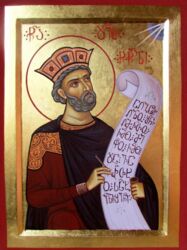 Our Psalms study is held on Tuesdays from 7:30 to 8:30 p.m., via Zoom. For registration, e-mail us at info@stjohnsmission.org.
Our BRIDGES program is held Wednesday nights at 155 Broadview. We read about and study the Orthodox faith, facilitated by Father Nicolaie, with guest speakers. The evenings start at 6:30 p.m., followed by compline at 8:00 p.m.
1) Narrated by Father Nicolaie, this 3½-minute video gives an introduction to the mission and people of the St. John’s community.
2) This 3-minute video introduces the viewer to the people and activities of the Mission’s affiliate in Scarborough, Good Neighbours Drop-In.
We are grateful to Peter for volunteering his time and skill.
Contact us to find out more about how you can contribute as a volunteer with the Mission or Good Neighbours.
Subscribe to our e-news list.
